



Natural Organic Food Products & Ingredient Sourcing Company
Top 10 Pomegranate Skin Powder Suppliers Worldwide
Choosing the right supplier matters when product quality, traceability, and consistent performance are essential. This guide examines the Top 10 Pomegranate Skin Powder Suppliers Worldwide through practical procurement criteria. It focuses on processing methods, raw material origins, testing practices, certifications, packaging, and export experience.
Pomegranate Skin Powder can vary in color, particle size, moisture, aroma, and active compound content. A reliable supplier should provide clear specifications and recent laboratory reports. Testing may include microbiological analysis, heavy metal screening, pesticide residue checks, and moisture control. Buyers should also confirm whether the powder is intended for food, cosmetic, or research applications. Standards differ by market.
Experience reveals small details. A clean, sealed package protects the powder from humidity and contamination. A responsive sales team can explain batch differences without making exaggerated claims. Traceable sourcing is equally important, especially when the supplier uses fruit skins collected from multiple processing sites. Documentation should be reviewed carefully. Website descriptions alone are not enough.
This list is not a permanent verdict. Supplier capacity, pricing, certifications, and availability can change. That limitation matters. Some companies communicate better than they document, while others offer strong reports but limited customization. Sample testing remains sensible before long-term purchasing. The following overview aims to help manufacturers, formulators, distributors, and quality teams compare credible options with greater confidence and fewer assumptions.
What Pomegranate Skin Powder Is and How It Is Produced
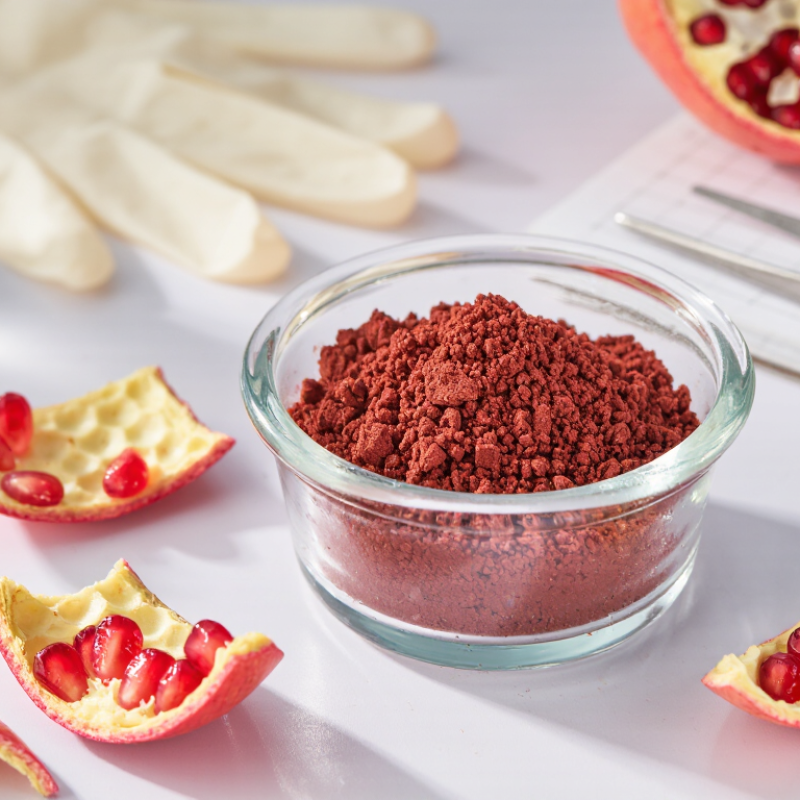
Pomegranate skin powder is made from the fruit’s outer rind, sometimes blended with the pale inner membranes. It is not simply dried juice residue. The rind contains fiber, polyphenols, and natural pigments, although levels vary with cultivar, maturity, and processing. UNEP’s Food Waste Index Report 2024 estimates that 1.05 billion tonnes of food were wasted in 2022. Using sound pomegranate skins can support by-product recovery, but it does not automatically make production sustainable.
Production begins with sorting and clean water washing. Foreign material and damaged skins must be removed. The material is then cut into small pieces and dried using controlled hot air, often below harsh temperatures that may reduce sensitive compounds. Some processors use freeze-drying, but it requires more energy and usually costs more. The dry rind is milled, sieved, and packed in moisture-resistant containers. It should look uniform, smell fresh, and remain free from visible mold.
Testing matters.
A reliable supplier checks moisture, microbial counts, pesticide residues, and heavy metals. The Codex General Principles of Food Hygiene, revised in 2022, supports risk-based controls across food processing. However, laboratory results can differ because sampling methods are not always consistent. This is an uncomfortable weakness. Buyers should request recent certificates, traceability records, botanical identification, and storage conditions. Pomegranate skin powder is useful, but its quality depends more on disciplined processing than on attractive claims.
Top 10 Pomegranate Skin Powder Suppliers Worldwide - What Pomegranate Skin Powder Is and How It Is Produced
The table presents ten major pomegranate-sourcing markets and typical supplier profiles. It does not rank or identify individual companies or brands. Actual specifications vary according to cultivar, harvest season, drying technology, milling conditions, and quality requirements.
| No. | Major Sourcing Market | Raw Material Used | Typical Production Process | Common Product Forms | Key Quality Parameters | Typical Applications |
|---|---|---|---|---|---|---|
| 1 | India | Outer rind and inner peel recovered from fresh-fruit processing | Sorting, washing, separation, controlled drying, coarse milling, fine pulverization, and sieving | Conventional peel powder; standardized polyphenol powder; extract-grade material | Moisture, particle size, total polyphenols, microbial count, pesticide residues, and heavy metals | Functional foods, botanical supplements, cosmetics, and research formulations |
| 2 | China | Fruit peel generated during juice, aril, and concentrate processing | Industrial washing, low-temperature or hot-air drying, hammer milling, sieving, and batch testing | Food-grade powder; cosmetic-grade powder; concentrated botanical ingredient | Identity, moisture, ash, mesh size, microbial limits, and contaminant screening | Tea blends, personal-care products, oral-care formulas, and ingredient research |
| 3 | Iran | Dried pomegranate rind from traditional and industrial fruit processing | Cleaning, sun or controlled-air drying, grinding, sieving, and packaging in moisture-resistant materials | Whole-peel powder; culinary powder; polyphenol-rich raw material | Color, odor, moisture, foreign matter, tannin or polyphenol content, and microbiological quality | Seasonings, traditional food preparations, supplements, and natural-color research |
| 4 | Turkey | Peel and rind from table-fruit and juice-processing streams | Fruit inspection, peel separation, controlled dehydration, milling, sieving, and lot traceability | Standard peel powder; finely milled cosmetic ingredient; extract feedstock | Moisture, particle distribution, total ash, polyphenol profile, pesticides, and microbiology | Cosmetics, herbal products, food-fiber blends, and laboratory applications |
| 5 | Spain | Peel by-product from commercial fruit, juice, and ingredient processing | Hygienic separation, rapid drying, controlled milling, sieving, and documented quality release | Food-grade powder; high-purity botanical powder; standardized extract material | Food-safety compliance, moisture, particle size, polyphenol content, and allergen controls | Functional beverages, bakery products, nutraceuticals, and skin-care formulations |
| 6 | Egypt | Rind and peel recovered from fresh pomegranates and fruit-processing residues | Washing, trimming, solar or mechanical drying, grinding, sieving, and sealed storage | Basic peel powder; food ingredient; botanical extraction feedstock | Moisture, foreign matter, microbial count, pesticide residues, and storage stability | Herbal preparations, food formulations, animal-feed research, and cosmetics |
| 7 | Afghanistan | Dried peel from locally cultivated and traditionally processed pomegranates | Manual sorting, washing, drying, low-speed grinding, and packaging for dry storage | Traditional peel powder; coarse culinary powder; raw botanical material | Moisture, cleanliness, mold absence, particle size, identity, and microbial testing | Traditional foods, herbal preparations, spices, and ingredient development |
| 8 | Azerbaijan | Pomegranate rind from regional fruit cultivation and juice production | Cleaning, dehydration, mechanical grinding, mesh classification, and dry-condition storage | Peel powder; food ingredient; polyphenol-containing raw material | Color, moisture, total polyphenols, microbial limits, heavy metals, and pesticide residues | Food products, beverages, supplements, and natural antioxidant research |
| 9 | Morocco | Peel and rind obtained from local fruit-processing operations | Sorting, rinsing, drying, milling, sieving, and packaging under low-humidity conditions | Conventional powder; cosmetic raw material; extract-grade peel | Moisture, odor, color, microbial quality, particle size, and trace contaminant testing | Skin-care products, soaps, herbal blends, and functional-food research |
| 10 | Tunisia | Pomegranate peel recovered from fresh-fruit and juice-processing residues | Peel separation, controlled drying, grinding, sieving, quality testing, and sealed packaging | Food-grade peel powder; cosmetic powder; extraction substrate | Moisture, particle size, total phenolics, microbial limits, pesticides, and heavy metals | Nutraceuticals, cosmetic formulations, beverages, and natural ingredient research |